Table of Contents
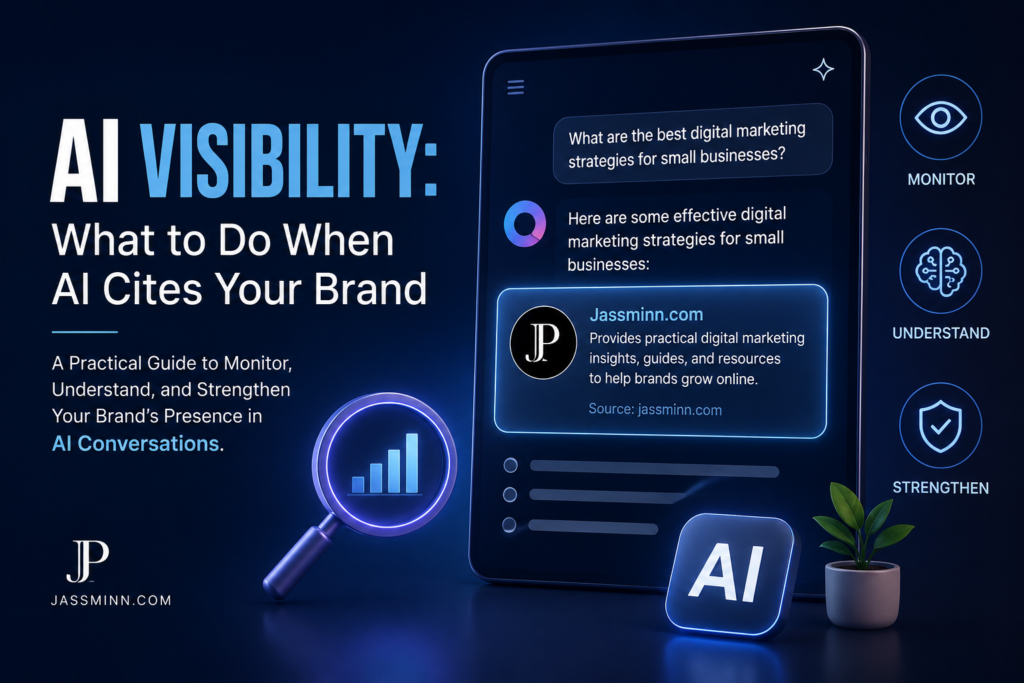
The first time you see your brand mentioned inside a ChatGPT or Perplexity answer, it feels like a win. And it is — AI visibility means your brand has moved beyond traditional blue links and into the actual conversations people are having with AI tools. However, the majority of marketers make the mistake of stopping at the mention. When their brand name appears in an AI response, they snap a screenshot and proceed.
That is incorrect. Accurate representation differs from a citation, and AI visibility only counts if the supporting data is correct.
I’ve dealt with this particular situation with client brands numerous times, and the pattern is consistently the same.AI starts citing you, the excitement kicks in, and then a closer look reveals gaps, outdated details, or even information mixed up with a competitor. This post walks through what to actually do once AI starts citing your brand, based on real situations I’ve handled — not theory.
Why Getting Cited Isn’t the Same as Getting It Right
It’s easy to view a brand’s initial appearance in an AI-generated response as a significant accomplishment and end there. In one instance I worked on, AI tools were mentioning a service page, but the information was lacking.
Because the AI was using a page that had not been updated in a long time, the explanation it provided consumers was brief and lacked important information.
The lesson here is simple: a citation is only useful if the source is trustworthy. If the underlying text is unclear or outdated, the AI will repeat what is there, gaps and all.
- Step 1: Verify What the AI Is SayingStep 1: Check Exactly What the AI Is Saying
- Before changing anything, read the citation carefully. Look at:
- • What claim or description is being made about the brand
- • Which page or source the AI appears to be pulling from
- • Whether the tone matches how the brand actually positions itself
- In one situation I handled, an AI tool was blending outdated information about a brand with details that actually belonged to a competitor. The only way to catch that was to compare, sentence by sentence, what the AI said against what was actually true.
- Step 2: Verify the Information Against Trusted Sources
- This is the step people skip. Once you know what AI is saying, compare it directly against the brand’s own website and other reliable sources — directories, review platforms, industry publications.
- In one situation I handled, an AI tool was blending outdated information about a brand with details that actually belonged to a competitor. The only way to catch that was to compare, sentence by sentence, what the AI said against what was actually true. That comparison told us exactly where the confusion started.
- Step 3: Identify the Gaps
- Step 3: Identify the Gaps Once you’ve verified the facts, the next step is figuring out why the AI got it wrong or incomplete in the first place. Usually it comes down to one of these:
- Gap Type What It Looks Like Common Cause
- Missing detail AI leaves out key specifics (pricing, service scope) Thin or outdated page content
- Wrong attribution AI credits a competitor’s feature to your brand, or vice versa Similar naming, unclear differentiation online
- Inconsistent info Different answers depending on the platform Conflicting details across website, directories, and social profiles
- Outdated info AI cites old pricing, old services, old positioning Content hasn’t been refreshed
- Mapping the gap type tells you exactly what to fix next.
- Step 4: Improve the Content AI Is Actually Pulling From
- Step 4: Enhance the Content That AI Is Really Using
- The actual job is done here. As soon as I determine which page the AI is referring to, I immediately update it with more precise information, FAQs that reflect the real queries users ask AI tools, and supporting material on related subjects.
- For instance, after realising that a service page lacked depth, I improved the internal linking so search engines (and AI crawlers) could link it to similar pages on the website, rebuilt it with clearer explanations, and added a FAQ section answering frequently asked questions by customers..
- Step 5: Strengthen Credibility Across the Web
- AI tools don’t rely on a single source. They cross-reference. So if your website says one thing but a directory listing or an old press mention says another, that inconsistency can show up in the AI’s answer.
- Go through the brand’s:
- • Website (services, pricing, about pages)
- • Directory listings
- • Review platforms
- • Any third-party publications that mention the brand
- Make sure the core facts — what you do, who you serve, how you’re different — are consistent everywhere. This is one of the most overlooked parts of AI visibility work, and it’s also one of the simplest to fix.
- Step 6: Monitor and Repeat
- This isn’t a one-time fix. After making updates, I re-run the same AI queries over time to track whether the description is becoming more accurate and consistent. Sometimes it takes a few cycles of updates and monitoring before the AI’s answer fully reflects the changes.
- The goal isn’t a single accurate citation — it’s a consistent pattern of accurate citations over time.
- A Simple Framework You Can Reuse
- Here’s the process, in order, any time you discover AI is citing your brand:
- 1. Check the citation — see exactly what’s being said and where it’s likely coming from
- 2. Verify the information — compare it against your own website and trusted sources
- 3. Identify the gaps — figure out whether it’s missing, wrong, inconsistent, or outdated
- 4. Improve the content — update or create the pages AI is actually pulling from
- 5. Strengthen credibility — keep facts consistent across your website and external platforms
- 6. Monitor regularly — repeat the same queries and track whether accuracy improves
- In short: Discover → Verify → Find Gaps → Improve → Build Trust → Monitor.
The Mistake Most Brands Make
The biggest mistake I see is treating AI citations as a vanity metric — more mentions, more excitement, no follow-through. A brand can be mentioned frequently and still be described inaccurately. That’s worse than not being mentioned at all, because inaccurate information erodes trust the moment a potential customer checks it against reality.
AI visibility should be treated the same way you’d treat your Google Business Profile or your reviews — something you monitor and correct, not something you set and forget.
FAQs
How often should I check how AI describes my brand? Monthly is a reasonable starting point for most brands, though anyone in a fast-changing industry (pricing, services, or offerings that shift often) should check more frequently.
Do I need special tools to see what AI says about my brand? No — you can start simply by asking AI tools direct questions about your brand, your services, and how you compare to competitors, and reviewing the answers manually.
Can fixing my website really change what AI says? Yes, though it isn’t instant. AI models re-crawl and re-reference sources over time, so updates typically show improvement over weeks or months rather than overnight.
Is AI visibility replacing traditional SEO? No. Strong, clear, well-structured content is still the foundation both traditional search and AI tools rely on — AI visibility builds on good SEO rather than replacing it.
Final Thoughts
Being cited by AI is a good sign — it means your brand has enough of a footprint to show up in these answers at all. But the real work starts after that first citation. Check what’s being said, verify it, close the gaps, and keep monitoring. That’s the difference between a brand that’s just mentioned and a brand that’s accurately and consistently represented across AI platforms.
On-Page SEO Notes
Internal linking opportunity: Link to an existing cornerstone page on structured data, technical SEO, or your services page (e.g., “we also checked the website’s structured data to make sure search engines could understand the business properly”).
External reference suggestion: Link to an authoritative source on AI/LLM citation behavior, such as Google’s Search Central documentation on structured data (https://developers.google.com/search/docs/appearance/structured-data/intro-structured-data), to support the credibility section.
Suggested image placements & prompts:
- Suggested image placements & prompts:
- 1. Hero image — prompt: “A brand dashboard showing AI chatbot citations alongside traditional search results, clean modern illustration.” Alt text: “AI visibility dashboard showing brand citations across AI tools”
- 2. Mid-article diagram — prompt: “Simple flowchart illustrating the six-step process: Discover, Verify, Find Gaps, Improve, Build Trust, Monitor.” Alt text: “Six-step AI visibility action framework diagram”
- 3. Gap comparison table graphic — prompt: “Side-by-side comparison graphic showing accurate vs inaccurate AI brand citation.” Alt text: “Comparison of accurate versus inaccurate AI brand citation examples”
- Schema recommendation: Article schema for the main post, plus FAQPage schema for the FAQ section.
- Word count (body text, omitting SEO notes): around 1,150 words
AI VISIBILITY